The Wild Family

Wild cats & their superpowers

Every cat alive — from a 300-kilo tiger to the tabby on your street — descends from one ancestor that prowled some 11 million years ago. Here are fourteen of those cousins, photographed in the wild, ranked by the things they do better than almost anything else on Earth.

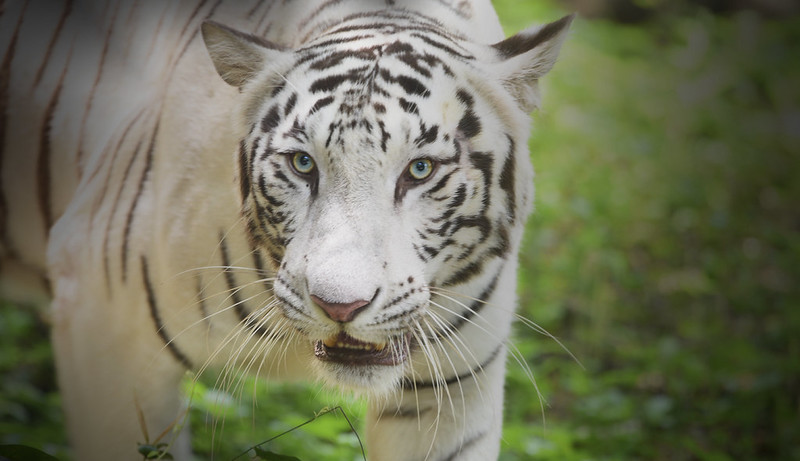
A white Bengal tiger gazing at the camera
Your sofa lion shares 95.6% of its DNA with this. Photo: lensnmatter · CC0

One family, many talents

The cat family, by the numbers

0
living species in the cat family (Felidae)
0
big cats that can truly roar: lion, tiger, leopard, jaguar
0
years since cats' common ancestor
0
of its DNA the house cat shares with the tiger

The roster

Fourteen wild cousins

Bars are eyeballed for comparison, not laboratory-exact — top speeds are real. Tap any photo to see it full-size.

Tiger

Panthera tigris

Raw power. Up to 300 kg of ambush muscle — the biggest cat that has ever lived.

Nose-to-tail it can reach 3.9 m. A solitary ambush hunter that swims happily, and every stripe — right down to the skin — is as unique as a fingerprint.

Speed65 km/h
PowerImmense
ClimbFair
LeapStrong

Lion

Panthera leo

Teamwork. The only truly social cat — it hunts and lives in prides.

A male's roar carries up to 8 km, warning rivals and calling the pride home across the grassland. Lionesses do most of the hunting, together.

Speed80 km/h
PowerHuge
ClimbLow
LeapStrong

Leopard

Panthera pardus

Climbing strength. It hauls kills heavier than itself straight up a tree.

The most adaptable of the big cats — from rainforest to the edge of cities. Pound-for-pound the strongest climber alive, it stashes its meals in the branches, safe from lions and hyenas.

Speed58 km/h
PowerHigh
ClimbElite
LeapGreat

Jaguar

Panthera onca

Bite force. The strongest bite of any big cat for its size.

The apex predator of the Americas kills unlike any other cat — a single bite straight through the skull. Strong enough to crack a caiman's armour or a turtle's shell, and it loves the water.

Speed80 km/h
PowerBone-crushing
ClimbGreat
LeapStrong

Cheetah

Acinonyx jubatus

Speed. The fastest land animal on Earth — 0–100 km/h in three seconds.

Built entirely for the sprint: a flexible spine, semi-retractable claws that grip like running spikes, and a long tail it uses as a rudder to corner at full tilt.

Speed120 km/h
PowerSlight
ClimbLow
LeapGreat

Snow Leopard

Panthera uncia

Leaping. It can clear 15 m (50 ft) in a single bound.

The “ghost of the mountains” cannot roar. Its metre-long tail is thrown out as a counterbalance on cliff-edge leaps — and wrapped around its face like a scarf against the cold.

Speed55 km/h
PowerSolid
ClimbElite
LeapUnmatched

Cougar · Mountain Lion · Puma

Puma concolor

Most names of any cat. Cougar, puma, mountain lion, catamount, panther — over 40 English names.

One animal, dozens of names, and the widest range of any land mammal in the Americas. It can spring 5.5 m straight up from a standstill — and, despite its size, it purrs rather than roars.

Speed80 km/h
PowerHigh
ClimbGreat
LeapExplosive

Lynx

Lynx lynx

Snow stealth. Snowshoe paws and radar ears for silent winter hunting.

Those black ear-tufts aren't decoration — they fine-tune its hearing. Wide, furred paws work like snowshoes, letting it stalk snowshoe hares across powder without a sound.

Speed50 km/h
PowerMedium
ClimbGood
LeapGreat

Bobcat

Lynx rufus

Adaptability. The most common wildcat in North America — and the most elusive.

About twice the size of a house cat, with a stubby “bobbed” tail. Most people who share their neighbourhood with one never see it: it hunts at dawn and dusk and melts into cover.

Speed55 km/h
PowerMedium
ClimbGood
LeapGreat

Serval

Leptailurus serval

Aerial catch. Leaps 3 m to pluck birds out of the air — and lands about half its hunts.

All legs and ears. The serval has the largest ears relative to its head of any cat and can hear rodents moving underground. Its ~50% strike rate is the best of any wild cat.

Speed80 km/h
PowerSlight
ClimbFair
LeapSpring-loaded

Caracal

Caracal caracal

Bird-swatting. A running leap knocks multiple birds clean out of the sky.

The desert acrobat. With one leap it can bat several birds down mid-flight — a skill so prized it was once trained for sport. Its long tufted ears swivel like antennae to pinpoint prey.

Speed80 km/h
PowerMedium
ClimbGood
LeapAcrobatic

Ocelot

Leopardus pardalis

Night vision. A nocturnal climber and swimmer that hunts in near-darkness.

A jungle jewel about twice the size of a house cat. It sleeps by day and hunts by night, its eyes built to gather the faintest light — and, unusually for a cat, it swims without complaint.

Speed60 km/h
PowerMedium
ClimbGreat
LeapStrong

Black Panther

melanistic Panthera

Camouflage & myth. Not a species at all — a black leopard or jaguar.

There is no such species as a “black panther.” It's a leopard or jaguar with a gene for extra dark pigment. Look closely in good light and the rosettes are still there, hidden like a watermark.

Speed58 km/h
PowerHigh
ClimbElite
LeapGreat

Street Cat

Felis catus

Adaptability. Your sofa lion's wild cousin is also… your sofa lion.

The same species as your pet, gone feral. Free-living domestic cats thrive on every continent but Antarctica, keeping every hunting instinct their wild ancestors had — proof the wild never fully left the house cat.

Speed48 km/h
PowerModest
ClimbGreat
LeapGreat

Why can only four cats roar?

Roaring cats — lion, tiger, leopard and jaguar — have a stretchy, un-hardened throat bone (the hyoid) that lets the whole throat vibrate. Every other cat, from the cheetah to the one on your lap, has a stiffened hyoid instead: it can't roar, but it can purr non-stop, in and out, for minutes at a time. You trade the roar for the purr.

Sound enabled — press any cat sound.